Your Ultimate Guide to a SIM Card for International Travel
The best SIM card for international travel is almost always a digital eSIM you buy online before you leave. It gives you instant data the moment you land, lets you skip those painful roaming fees, and saves you the hassle of fumbling with tiny plastic cards. For modern travelers, it's a total game-changer.
Why Your Home Phone Plan Isn't Enough for Travel
Nothing sours the memory of an incredible trip faster than getting slapped with a massive, unexpected phone bill when you get home. This guide is your battle plan to make sure that never happens.
We’re going to walk through the headache of roaming fees and show you the simple, modern solutions that make them a thing of the past. Think of this as your roadmap to smart travel connectivity. By the time you’re done reading, you’ll know exactly what you need—whether it’s a slick new eSIM or a trusty physical SIM—long before you even start packing. A few minutes of prep now can literally save you hundreds.
The Problem with Roaming Fees
Picture this: you've just had an amazing two-week adventure in Europe. You get home, open your phone bill, and see a gut-wrenching charge for roaming—sometimes as high as $10 per day, or even more. It's a nightmare scenario that’s pushing more and more travelers to find a better way. The most popular solution? A travel eSIM that lets you download a local data plan straight to your phone.
The market data tells the same story. The global Travel eSIM market is on track to explode from USD 585.33 million in 2025 to USD 709.68 million in 2026. That's a massive 21% jump in just one year. Projections show it rocketing to USD 1.85 billion by 2032. You can dig into the numbers yourself by reading the full market analysis on GlobeNewswire.
A Smarter Way to Stay Connected
A dedicated SIM card for international travel lets you completely sidestep those outrageous charges by connecting you directly to local mobile networks. Instead of "roaming" on a foreign network through your provider back home, you essentially become a temporary local customer.
This simple switch gives you a few massive advantages:
- Huge Cost Savings: You pay local rates for data, which are almost always just a fraction of what your home carrier charges for an international package.
- Better Speeds and Reliability: By connecting directly to the best local 4G/5G networks, you get faster, more stable internet than you typically would when roaming.
- Total Flexibility: You can pick from tons of different plans based on your needs, whether you just need 1 GB for a weekend trip or 50 GB for a month-long journey.
The big idea is simple: instead of renting temporary, marked-up access to a foreign network, you're just buying a prepaid plan like a local would. That one strategic shift is the secret to affordable, stress-free connectivity all over the world.
Physical SIM vs. eSIM: The Modern Traveler's Dilemma
Choosing how to stay connected abroad feels a lot like deciding between a classic paper map and a slick GPS app on your phone. The physical SIM card is that old, reliable map—it’s familiar, you know exactly how it works, and there’s a certain comfort in holding the tangible thing. Then you have the eSIM, which is like the GPS app—instant, flexible, and built right into your device.
This choice is one of the biggest decisions a modern traveler makes, a constant tug-of-war between old-school reliability and new-school convenience. So let's break down both to figure out which one makes the most sense for your next trip.
Before we dive in, this flowchart perfectly captures the main reason we're even having this conversation: ditching those insane roaming fees and keeping more money in your pocket for the actual trip.
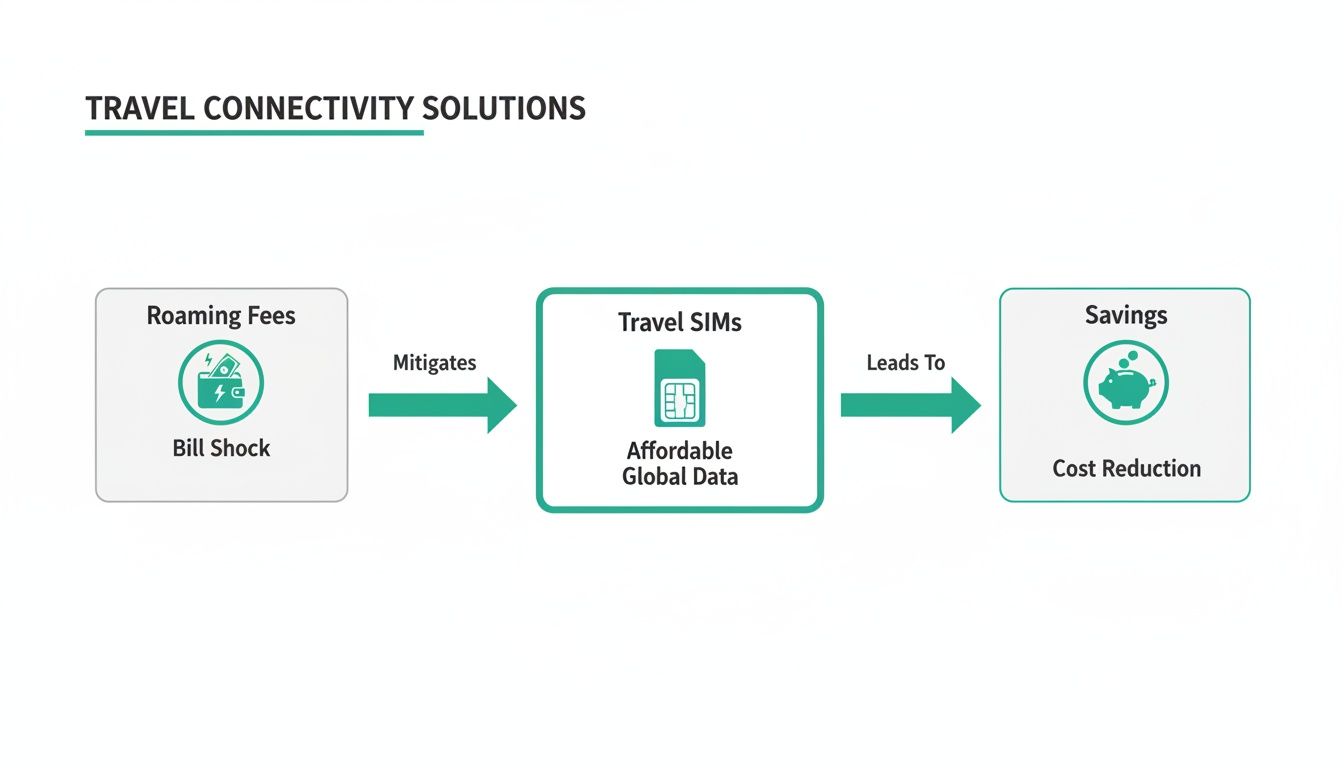
It’s a simple path from the headache of high costs to the relief of a smart, affordable solution.
The Familiar World of Physical SIM Cards
For decades, the physical SIM card was the only game in town. It’s that tiny little chip you pop into your phone to get on a mobile network. When you’re traveling, this usually means buying a local SIM card as soon as you land, whether at an airport kiosk, a corner store, or a carrier’s shop.
This traditional route still has its place, and for good reason. Physical SIMs are almost universally compatible, working with just about any phone ever made, including older models that have never heard of an eSIM. They’re also everywhere, making it incredibly easy to grab one on the fly, sometimes for just a few bucks.
But that’s where the convenience often stops. The reality involves hunting down a reputable seller, fumbling with a tiny SIM ejector tool (or, let’s be honest, a paperclip), and then trying not to lose your precious home SIM card in your bag. It’s a tangible solution, but it can feel clumsy and outdated.
Enter the eSIM: A Digital Revolution
An eSIM, or embedded SIM, is the digital-native cousin to the plastic SIM. It’s not a physical card but a small chip that’s already built into your phone’s motherboard. Instead of swapping out little pieces of plastic, you just download a data plan by scanning a QR code or activating it through an app. This is where travel connectivity really changes.
The real magic of an eSIM is its immediacy. You can buy and set up a data plan from your couch before you even leave home. That means you’re connected the second your plane’s wheels hit the tarmac. No more frantic searches for airport Wi-Fi or waiting in line at a kiosk.
The flexibility is another huge plus. Your phone can store multiple eSIM profiles at once. Imagine having a plan for Europe, another for Southeast Asia, and a third for the U.S., all ready to go. You can switch between them with just a few taps in your phone’s settings. If you want to get into the nitty-gritty, our guide on what an eSIM is and how it works has you covered.
Physical SIM vs. eSIM: A Quick Comparison for Travelers
To make the choice crystal clear, let's put these two head-to-head on the features that really matter when you're on the road. This table breaks down the key differences to help you decide which is the right fit for your travel style.
| Feature | Physical SIM Card | eSIM (Embedded SIM) |
|---|---|---|
| Activation | Requires physically inserting a plastic card, often after hunting down a local store. | Instant digital activation by scanning a QR code or using an app—can be done pre-trip. |
| Flexibility | You’re locked into one plan per SIM. Switching plans means physically swapping cards. | You can store multiple plans at once and switch between them in your phone’s settings. |
| Availability | Widely available at airports and local shops; perfect for on-the-spot purchases. | Purchased online anytime, anywhere, but your phone must be eSIM-compatible. |
| Security | The card can be lost or stolen. You also risk losing your home SIM during the swap. | Can't be physically lost or damaged since it’s embedded in your device. |
| Compatibility | Works with nearly any unlocked phone, especially older or more basic models. | Supported by most newer smartphones from Apple, Samsung, Google, and others. |
While physical SIMs once ruled the world, eSIMs are catching up fast. Projections show that the number of devices with eSIMs will jump to 1.5 billion worldwide in 2026, up from 1.2 billion in 2025. And with smartphone eSIM penetration expected to rocket from 28.9% in 2024 to 57.7% by 2030, it’s clear that digital activation is becoming the new standard.
Ultimately, the best choice boils down to your phone, how comfortable you are with new tech, and your travel habits. For most modern travelers, though, the sheer convenience and flexibility of an eSIM are pretty tough to beat.
How to Choose the Best International SIM Plan
Deciding between a physical SIM and an eSIM is just the start. Now for the fun part: finding a plan that actually delivers on its promises without those nasty hidden fees. It can feel like you're drowning in options, but knowing what to look for transforms you from a confused tourist into a savvy buyer.
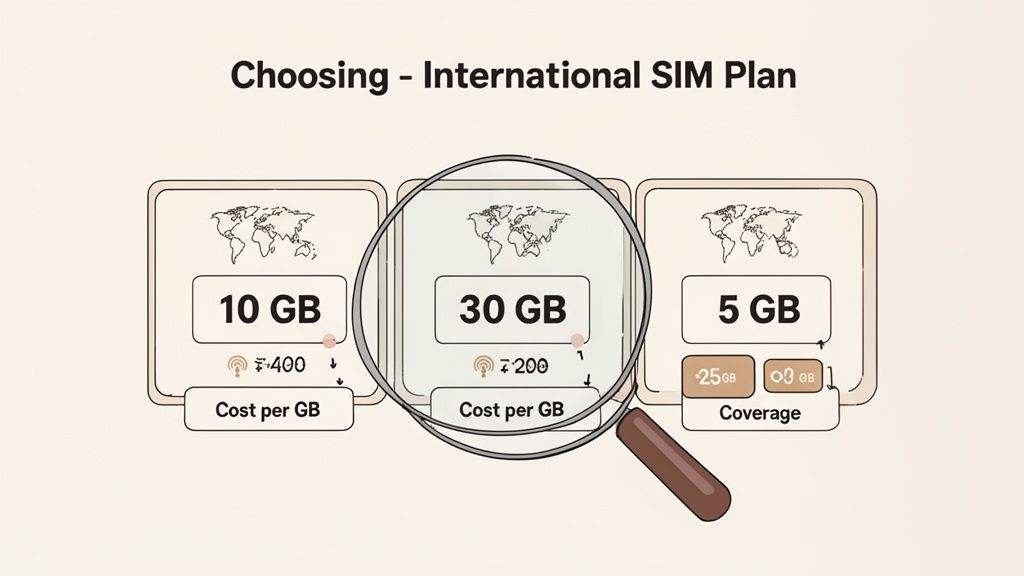
Here's the secret: ignore the flashy headline price. Instead, zero in on the two numbers that reveal a plan's true worth: cost per gigabyte (GB) and daily data cost. These metrics cut through the marketing fluff and tell you exactly what you're paying for.
Decoding Plan Value Like a Pro
That $10 plan might seem like a bargain, but if it only gives you 1 GB of data for a week-long trip, you're paying a premium. On the other hand, a $20 plan with 10 GB of data is a much better deal at just $2 per GB. This is the simple math that separates the good deals from the bad ones.
Here’s how you break it down:
- Cost per GB: Just divide the total price by the number of gigabytes you get. This is the single best way to compare raw data value.
- Daily Data Cost: Divide the total price by the number of days the plan is active. This helps you frame the cost in terms of your travel budget.
Take a plan offering 5 GB for 15 days at $15. The cost per GB is a solid $3, and the daily cost is just $1. This quick calculation instantly shows you which sim card for international travel is the real winner. To see just how much this saves you, check out our guide on how to avoid roaming charges.
By focusing on these two key figures, you can confidently compare apples to apples. It ensures you’re paying for the data you actually need, not just a low initial price designed to catch your eye.
Assessing Your Real Data Needs
Before you hit "buy," take an honest look at how you use your phone on the road. It's easy to overbuy data "just in case," but that's a classic way to overspend. Underestimating, though, can leave you stranded without Google Maps when you need it most.
Think about which traveler profile you fit into:
- Light User: You're mostly on Wi-Fi but need data for maps, messaging, and the occasional social media post. (1-3 GB per week)
- Moderate User: You're frequently using maps, streaming music, uploading photos, and making a few video calls. (5-10 GB per week)
- Heavy User: You might be working remotely, streaming Netflix, or using your phone as a hotspot for other devices. (15+ GB per week)
Knowing which camp you fall into helps you pick a data package that feels just right, so you aren't paying for gigabytes that go to waste.
Coverage and Plan Type
Finally, where you're going matters—a lot. The perfect plan for a Paris city break is probably the wrong choice for a trek through rural Vietnam.
- Check the Coverage Map: Always, always check the provider’s coverage map for your specific destinations before you buy. This is non-negotiable if you’re heading anywhere outside of major cities.
- Country-Specific vs. Regional Plans: If you're staying put in one country, a local plan is almost always cheaper. But for a multi-country Euro-trip or a tour of Southeast Asia, a regional plan (like a "Europe" or "Asia" eSIM) is a lifesaver, giving you seamless data as you cross borders.
The explosion in the travel eSIM market is a direct response to travelers finally saying "no" to those absurd 200-500% markups on roaming. With the market projected to jump from USD 1.76 billion in 2025 to USD 7.62 billion by 2034, all that competition is pushing prices down. By using platforms like eSimGuide.com to compare plans, travelers can easily find deals with an average cost per GB under $1, completely changing the game for staying connected.
Finding the Right Connectivity for Your Travel Style
Picking the right sim card for international travel isn’t a one-size-fits-all deal. The best plan for you is deeply personal, shaped by where you’re going, your budget, and how glued to your phone you really are. What works for a week-long beach vacation will absolutely fall short for a digital nomad on a three-month tear through Europe.
To make this real, let's look at four classic traveler types. See which one sounds like you, and you’ll be able to nail down the exact strategy to stay connected without overspending or—even worse—running out of data mid-adventure.
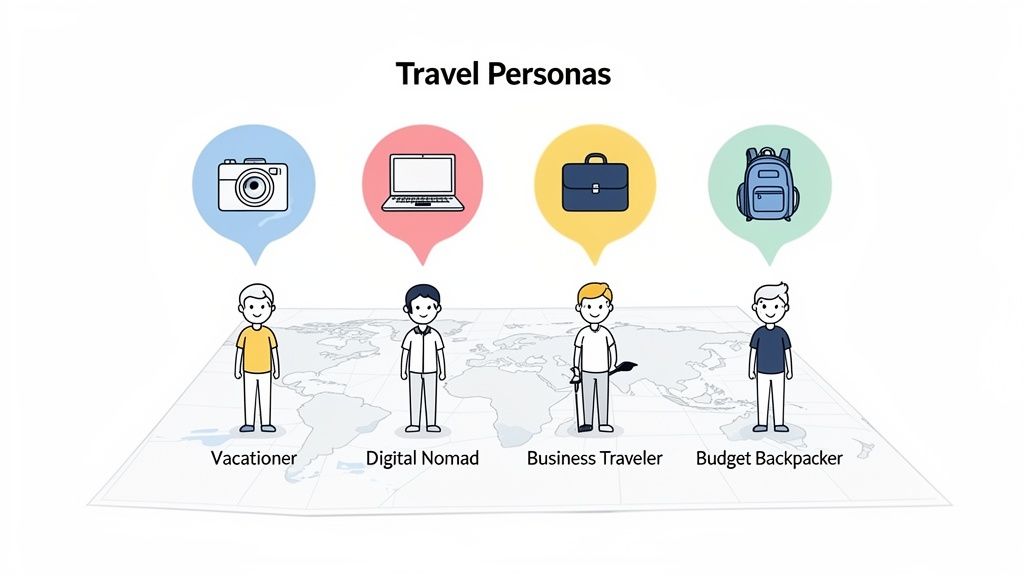
The Casual Vacationer Keeping It Simple
Meet Sarah, the Vacationer. She’s heading to Italy for ten days to hit Rome and the Amalfi Coast. Her needs are simple: Google Maps for navigating ancient streets, Instagram for photo dumps, and WhatsApp to check in with family. She’s not working or streaming movies; she just needs data that works without a fuss.
For Sarah, the name of the game is convenience. The last thing she wants is to waste an hour of her vacation hunting for a SIM shop.
- Best Strategy: A country-specific eSIM she buys before her trip.
- Ideal Plan: Something with 3-5 GB of data that’s valid for 15 days. This gives her more than enough data for her trip without paying for a full month she won’t use.
- Why It Works: She can install the eSIM from her couch at home and fire it up the second she lands. It's a true "set it and forget it" solution that lets her focus on gelato, not her phone bill.
The Digital Nomad Powering Productivity
Next up is Alex, the Digital Nomad. He’s about to spend the next three months working from cafes in Lisbon, Valencia, and Split. For him, a solid, high-speed connection isn't a nice-to-have—it's his entire livelihood. He needs enough data for Zoom calls, uploading huge files, and turning his phone into a hotspot when the cafe Wi-Fi inevitably flakes out.
Alex is all about big data, multi-country coverage, and long-term value. A tiny 7-day plan just isn't going to cut it.
- Best Strategy: A regional eSIM with a massive data allowance.
- Ideal Plan: A "Europe" plan with 50-100 GB of data valid for 90 days. This gives him totally seamless connectivity as he hops from one country to the next.
- Why It Works: Buying one huge plan is way more cost-effective than juggling multiple smaller ones. A regional plan means he never thinks twice about crossing a border; his connection just keeps working.
The key for nomads and long-term travelers is to think in terms of months, not days. A regional plan with a generous data cap offers both the lowest cost per gigabyte and the greatest operational freedom.
The Business Traveler Needing Instant Reliability
Now consider Maria, the Business Traveler. She’s flying to Tokyo for a critical 72-hour trip packed with back-to-back meetings. For her, being offline isn't an option. She needs flawless connectivity the moment her plane touches down to check emails, join last-minute video calls, and use maps to get to her appointments on time.
Maria’s top priority is absolute reliability and zero downtime. Cost is a distant second to performance.
- Best Strategy: A premium eSIM from a provider known for using top-tier local networks.
- Ideal Plan: An unlimited data plan valid for 3-5 days. Sure, they're more expensive, but they completely eliminate the risk of running dry at a crucial moment.
- Why It Works: An unlimited plan removes all data anxiety. She can use her phone as much as she needs without a second thought, ensuring she’s always ready and reachable.
The Budget Backpacker Maximizing Every Dollar
Finally, we have Leo, the Budget Backpacker. He’s embarking on a six-week adventure through Southeast Asia, hitting Thailand, Vietnam, and Cambodia. His mission is to make his money last, which means every dollar spent on data is a dollar not spent on street food or a cool hostel. He’s fine using Wi-Fi when he can, but needs data for maps and messaging on the go.
Leo is laser-focused on one thing: the lowest possible cost per gigabyte.
- Best Strategy: Buying local physical SIM cards in each country he visits.
- Ideal Plan: Small, prepaid data packages bought from official carrier stores—not the overpriced airport kiosks.
- Why It Works: In many parts of the world, especially Southeast Asia, local SIMs offer ridiculously cheap data—we’re talking a few bucks for 30 GB. It’s less convenient than a regional eSIM, but for a long-term, budget-conscious trip, the savings are massive. This route takes a bit more effort but delivers the absolute best bang for your buck.
Your Step-by-Step Activation and Troubleshooting Guide
You've picked out the perfect sim card for international travel and you're ready to fly. Awesome. Now for the most important part: actually getting it to work when you land.
Most of the time, activation is dead simple. But a few small steps can be the difference between getting instant data and staring at a "No Service" message in frustration. This guide will walk you through the process for both physical SIMs and eSIMs, then cover the fixes for the most common hiccups.
Think of this as your pre-flight connectivity checklist. A few minutes now saves a major headache later.
Activating Your eSIM Before You Travel
The real magic of an eSIM is that you can set it all up from your couch before you even leave for the airport. This gets you online the second your plane's wheels touch down. The whole thing is digital and takes just a few minutes.
-
First, Check Compatibility: Before you buy anything, make sure your phone is unlocked and supports eSIM. Most newer smartphones do, but it's always smart to double-check. If you're not sure, our guide on how to check if your phone supports eSIM will give you a clear answer in seconds.
-
Purchase and Install: Once you buy a plan online, you’ll get a QR code in your email. Just head to your phone’s cellular settings, tap "Add eSIM," and scan that code. Your phone will download the travel plan right onto your device.
-
Label Your New Plan: Your phone will prompt you to name the new eSIM. Give it a memorable label like "Spain Trip" or "Thailand Data." This makes it way easier to tell it apart from your home SIM when you’re toggling settings.
-
Wait to Activate: This is key. Don't actually turn the plan on until you arrive. Most plans start their countdown (e.g., 7 days) the moment they connect to a network. You don't want to burn a full day of service while you're still on the plane.
Activating Your SIM After You Arrive
Whether you've got a physical SIM you bought online or one you just grabbed at the airport, the action starts once you land.
For a classic physical SIM, it’s a hands-on process.
- Pop open your phone's SIM tray with an ejector tool (or the end of a paperclip).
- Take your home SIM out and stash it somewhere safe—you'll need it when you get back.
- Slide the new travel SIM in, close the tray, and restart your phone.
If you already installed your eSIM back home, it's even simpler.
- Dive back into your phone's cellular settings.
- Find the travel eSIM you labeled earlier and toggle it on.
- Now, the crucial step: turn on Data Roaming for your travel eSIM. It sounds weird, I know, but this is what allows your eSIM to connect to local partner networks abroad.
Important Takeaway: To make your travel eSIM work, you must enable Data Roaming in its settings. At the same time, make absolutely sure that Data Roaming is turned off for your primary home SIM to dodge those nightmare roaming bills from your carrier.
Troubleshooting Common Connectivity Problems
Even with the best prep, sometimes things just don't click. If you land and find yourself without data, don't panic. These field-tested tricks solve over 90% of the activation issues I see.
Problem 1: No Signal or a "No Service" Message
This is easily the most common snag. Your phone recognizes there's a new SIM, but it just can't seem to hook up to a network.
- Solution 1: The Airplane Mode Trick. The simplest fix is often the best. Just toggle Airplane Mode on for about 30 seconds, then switch it off. This forces your phone to do a fresh scan for all available networks in the area.
- Solution 2: Select a Network Manually. If that doesn't work, head into your phone’s network settings and switch off "Automatic" network selection. Your phone will search for a minute and then show you a list of local carriers. Pick one of the providers that your eSIM company mentioned in their instructions.
Problem 2: Connected to a Network, But No Internet
You see signal bars and the carrier's name at the top of your screen, but none of your apps can get online. This almost always points to one thing: the APN.
- Solution: Check Your APN Settings. The APN (Access Point Name) is basically the gateway your phone uses to access the internet through the mobile network. Sometimes these settings don’t update on their own. Your SIM provider will have the correct APN details in their welcome email or setup guide—just go into your phone's settings and make sure they match exactly.
Common Questions About Travel SIMs
Even with a plan in place, a few last-minute questions always pop up. Here are straight answers to the most common things travelers ask before they fly.
Can I Still Get Calls and Texts on My Regular Phone Number?
Yes, you absolutely can. This is one of the best parts about using a travel eSIM for data. Your phone's dual-SIM capability means you can use the international eSIM for cheap data while keeping your primary line active for any incoming calls or texts from back home.
You just have to get your settings right. Set your travel eSIM as the primary source for "Cellular Data" but keep your home SIM as the "Default Voice Line." This little trick lets you dodge those crazy data roaming fees from your home carrier without missing important calls or two-factor authentication texts.
Think of it as giving your phone two jobs: your home SIM handles the calls, and your travel SIM handles the internet. You stay connected on your regular number while browsing at cheap local prices.
How Do I Know if My Phone Is Unlocked?
To use a SIM card for international travel from any provider other than your own, your phone needs to be "unlocked." A locked phone is simply one that’s tied to a specific carrier, usually because you're still paying it off.
Here are two foolproof ways to check:
- The Swap Test: This is the easiest way. Just borrow a SIM card from a friend who uses a different carrier. Pop it in your phone—if you can make a call or send a text, your phone is unlocked and ready to go.
- Call Your Carrier: If you can't borrow a SIM, just call your mobile provider and ask them directly. If your phone is fully paid off, they have to unlock it for you. It's the law.
Is It Cheaper to Buy a SIM Card at the Airport?
It might be convenient, but buying a SIM at the airport is almost always a rip-off. Kiosks in the arrivals hall know you're a captive audience and jack up the prices.
You can expect to find much better deals—often 50% cheaper or more—if you wait until you're in the city. Just head to an official carrier store or even a local convenience store. For the best of both worlds (price and convenience), buying an eSIM online before you even leave home is the winning move.