Your Guide to Prepaid SIM Card USA for Seamless Travel
Getting a prepaid SIM card in the USA is your golden ticket to dodging those eye-watering international roaming fees. Think of it as a simple, no-strings-attached pass for your phone, giving you affordable data, calls, and texts on US networks without getting locked into a contract.
Your Guide to Staying Connected in the USA
Landing in a new country is disorienting enough without being cut off from the world. We’ve all been there—trying to hail a rideshare, navigate with Google Maps, or just find a decent coffee shop becomes a massive headache when you have no signal. Relying on your home carrier’s roaming plan? That’s a recipe for bill shock. It’s not uncommon for travelers to come home to hundreds of dollars in surprise charges.
A prepaid SIM card for your US trip is the smartest way to avoid that mess. It’s basically a temporary key to the local mobile network. You buy a plan upfront with a set amount of data, minutes, and texts that’s good for a fixed period, like 15 or 30 days. Once it’s done, it’s done. No surprise fees, no credit checks, and no messy cancellation process.
Why Every Traveler Needs One
This pay-as-you-go approach gives you freedom and control, which is exactly what you need on the road. Whether you're a tourist on a week-long getaway or a digital nomad settling in for a month, a prepaid plan ensures you have fast, reliable internet without emptying your wallet. Suddenly, your smartphone goes from a potential financial liability to your most powerful travel companion.
For a deeper dive into available options, you can explore detailed guides like this one for the United States: https://esimguide.com/countries/united_states_of_america
Of course, a solid data plan is just one piece of the puzzle. A smooth journey often depends on having the right setup. To round out your kit, check out these other essential tools for perpetual travelers that cover everything from planning to logistics.
Two Paths to Connectivity
Throughout this guide, we'll walk through the two main types of prepaid options you’ll come across:
- Physical SIM Cards: The classic, pop-it-in plastic chip. They are available everywhere and work with nearly any unlocked phone.
- eSIMs (Embedded SIMs): The modern, digital version that's built right into newer smartphones. You activate it instantly with a QR code, which means you can get online the moment you touch down.
Choosing the right prepaid plan for the USA comes down to your phone’s compatibility, how much data you’ll burn through, and your travel style. Let's figure out how to make the best choice for your trip.
Understanding Physical SIMs vs Digital eSIMs
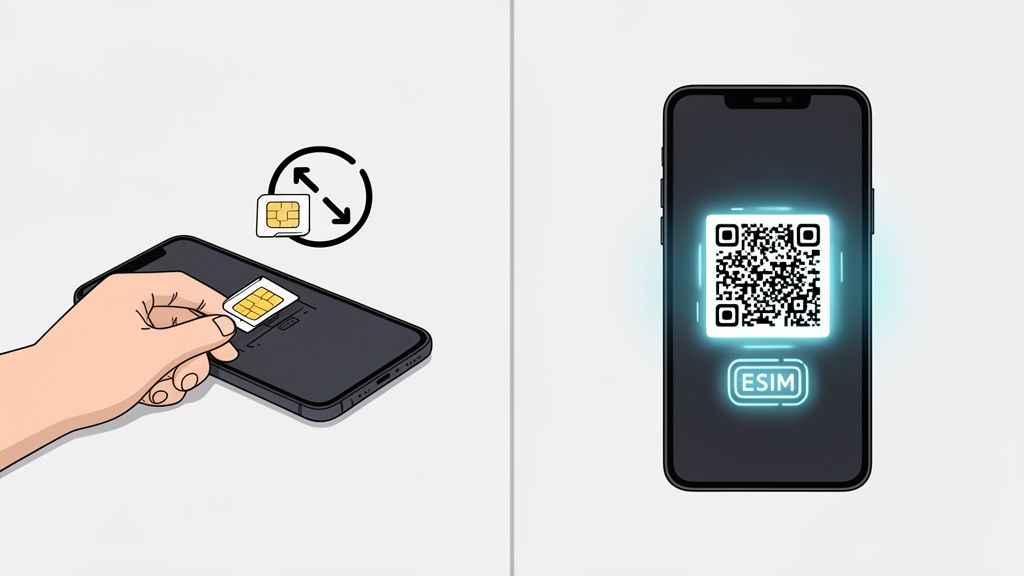
Before you can pick a plan, you have a more fundamental choice to make: will you go with a classic physical SIM card or its modern, digital cousin, the eSIM? Getting this right is the first step to a hassle-free, connected trip.
Think of it this way: a physical SIM is like a physical key to a rental car. You have to pick it up, it’s a tangible object you can lose, and you have to physically insert it into the ignition to get the car started. It’s a method that’s worked for decades.
An eSIM, on the other hand, is like the keyless entry code for that same car. The "key" is already built into the car's electronics; you just need to beam over the right digital code to unlock it and drive away. It's faster, more secure, and you can’t accidentally drop it down a sewer grate.
The Classic Physical SIM Card
A physical prepaid SIM card for the USA is exactly what it sounds like—that tiny, removable plastic chip you slide into your phone's SIM tray. For a lot of travelers, especially those with slightly older phones, this is the default, no-fuss option.
Its biggest selling point is its near-universal compatibility. As long as your phone is "unlocked" (meaning it’s not tied to your carrier back home), it will almost certainly work with a physical SIM from a US provider. You can grab one at an airport kiosk, a 7-Eleven, or a carrier store right after you land.
But that convenience comes with a catch. You’re stuck hunting for a store right after a long flight, fumbling with a tiny piece of plastic, and keeping track of your original SIM so you don't lose it. It's a process that feels a bit dated in an otherwise digital travel world.
The Modern eSIM Advantage
An eSIM, or "embedded SIM," is a game-changer. It’s a tiny chip that’s already soldered into your phone's motherboard. Instead of a plastic card, you get a QR code from your provider. Just scan it, follow a few prompts, and your US mobile plan downloads directly to your device.
For travelers, this is a massive leap forward. You can buy your prepaid SIM card USA plan from a site like eSIM Guide days or even weeks before you leave home. This means the second your plane touches down in the US, your phone is ready to connect. No lines, no SIM popper tools, no stress.
This digital-first approach is rapidly becoming the new standard. The prepaid SIM market is projected to grow at a blistering 19.6% rate through 2030, largely driven by the adoption of eSIM technology. With eSIMs set to make up 28% of all SIM shipments in 2024, they are fundamentally changing how we travel, cutting activation times by an estimated 70% compared to physical SIMs.
The ability to set up your US data plan before you travel is the single biggest advantage of an eSIM. It removes the stress of finding a SIM vendor upon arrival and gets you connected instantly.
Physical SIM vs eSIM At a Glance
So, which one is right for you? It really comes down to your phone, your travel style, and how comfortable you are with new tech. This table breaks down the key differences to help you decide.
| Feature | Physical SIM Card | eSIM (Digital SIM) |
|---|---|---|
| Setup Process | Requires physically inserting a chip into the phone's SIM tray. | Activated instantly by scanning a QR code or through an app. |
| Availability | Can be purchased at airports, retail stores, and carrier outlets in the USA. | Purchased online from anywhere, anytime before your trip. |
| Device Compatibility | Works with nearly any unlocked phone, including older models. | Supported by most newer flagship phones (iPhone, Samsung, Pixel). |
| Convenience | Less convenient; you must find a seller and can lose the tiny chip. | Extremely convenient; no physical parts to lose, instant setup. |
| Flexibility | Swapping between plans requires swapping physical cards. | Easily switch between multiple eSIM plans stored on your device. |
Ultimately, if you have a newer phone, an eSIM is almost always the superior choice for convenience and flexibility. But if you're rocking an older device, the trusty physical SIM is still a perfectly reliable way to get connected.
For a deeper dive, check out our full guide on what an eSIM is and how it works.
Navigating Major Carriers vs. MVNOs
When you start looking for a prepaid SIM card in the USA, you'll quickly run into two kinds of providers: the massive household names you see advertised everywhere, and a bunch of smaller, often online-only brands you’ve never heard of. Figuring out the difference is the secret to getting a great deal for your trip.
Think of the US mobile network as a giant highway system. The major carriers—AT&T, T-Mobile, and Verizon—are the companies that literally built and own these highways. They have all the control, the biggest stores, and premium features.
Then you have Mobile Virtual Network Operators, or MVNOs. They're like delivery companies that lease trucks to drive on those same highways. They don't own the roads, but they use them to offer their own services, usually with more specialized and much more affordable plans. For a traveler, this difference is everything.
The Major Carriers Explained
The "Big Three"—often called Mobile Network Operators (MNOs)—are the bedrock of all cell service in the United States. When you buy a plan directly from them, you're getting service straight from the source.
- Premium Service: You generally get the fastest possible data speeds and priority on the network when it's busy. Their plans also come with perks like streaming service subscriptions.
- Massive Physical Presence: You can walk into one of their official stores in almost any city to get face-to-face help, which can be comforting.
- Higher Costs: All that premium service and those thousands of retail stores don't come cheap. Their prepaid plans are almost always more expensive than an MVNO.
For travelers, buying from a major carrier is the most straightforward route, but it's rarely the cheapest. It’s like booking your flight directly with a legacy airline—totally reliable and full-featured, but you’re definitely paying extra for the brand name.
The Power of MVNOs for Travelers
This is where the real value is hiding for most visitors. MVNOs are smaller companies that buy network access in bulk from the major carriers and then resell it to people like you. Brands like Mint Mobile, Ultra Mobile, and US Mobile are all popular MVNOs.
Because they don't have the insane overhead of maintaining a nationwide network or thousands of storefronts, MVNOs can pass those savings directly to you. They often zero in on specific customer needs, with plans that are practically tailor-made for short-term visitors who just want a simple, data-heavy prepaid SIM card USA plan.
An MVNO gives you access to the exact same reliable cell towers and 5G speeds as a major carrier, but for a fraction of the cost. You get the quality of a premium network with the pricing of a budget-friendly service.
This business model lets them offer incredibly flexible, short-term plans without the credit checks or long-term contracts you'd find at a major carrier. For a tourist, it's a perfect match. You get exactly what you need—data and maybe a few calls—for the length of your trip, without paying for extras you'll never use.
Why MVNOs Are a Traveler's Best Friend
So, what makes an MVNO the smarter choice for a trip to the USA? The benefits are clear and hit on exactly what a person on the move needs.
- Cost-Effectiveness: This is the big one. MVNOs consistently give you more data for your dollar. It’s not even close.
- Flexibility: Their plans are usually built for shorter terms (30 days or less) and can be bought online in minutes, often as an eSIM you can set up before you even land.
- Simplicity: The plans are wonderfully straightforward. You pick how much data you want, and that's it. No confusing add-ons or sneaky hidden fees.
Think of it like choosing between a major hotel chain and a fantastic Airbnb. The hotel is predictable and has a huge staff, but the Airbnb often delivers way better value and an experience that fits your actual needs. This is why platforms like eSimGuide.com are so useful—they specialize in highlighting these cost-effective MVNO options, making it dead simple to compare plans and find the perfect one for your travel budget.
Alright, you've figured out whether you're going with a major carrier or an MVNO. Now for the fun part: actually getting your hands on a SIM card.
Figuring out where to buy your prepaid SIM card USA plan is a decision that can really shape the first few hours of your trip. You basically have three paths: buy it online before you go, grab one at the airport when you land, or hunt one down in a retail store after you've settled in.
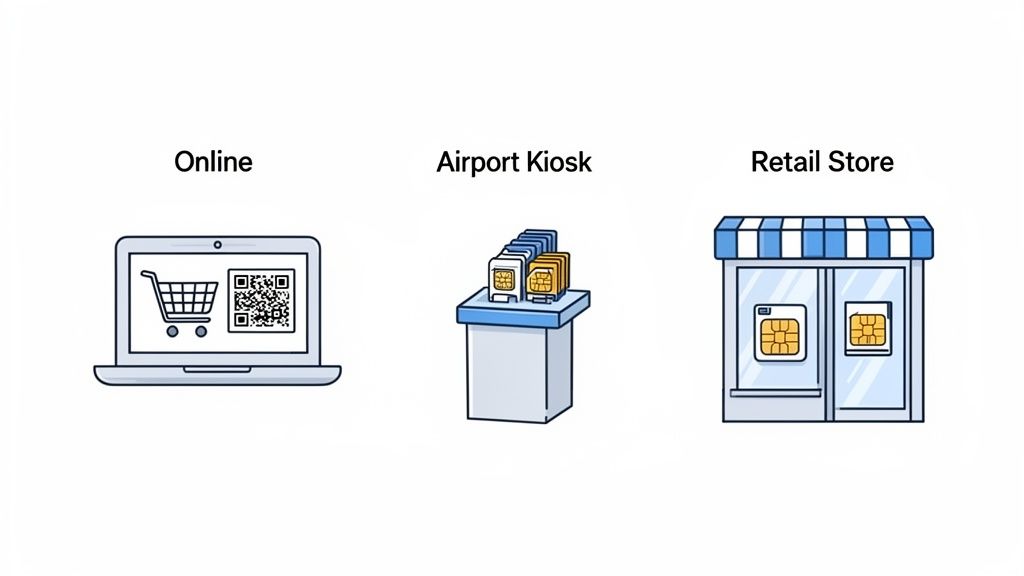
So, what’s more important to you? Do you want that sweet, sweet internet connection the second the plane's wheels touch the tarmac? Or are you okay with a bit of a scavenger hunt to find a better deal? Each option has its own pros and cons, tailored for different kinds of travelers.
For tourists and digital nomads flying into hubs like NYC or LA, a prepaid plan from AT&T Prepaid or T-Mobile Connect means you’re online instantly, no credit checks or contracts needed. It’s a huge market for a reason—by 2034, the U.S. prepaid slice alone is expected to hit a staggering USD 10.62 trillion. That growth shows just how essential a good prepaid SIM has become for any smooth American adventure.
Option 1: Buying Online Before Your Trip
This is, hands down, the easiest and most relaxed way to get connected, especially if your phone supports eSIM. Buying your plan online from a provider’s website or a comparison platform means you get everything sorted from your couch, days or even weeks before you pack your bags.
If you go the eSIM route, you'll get a QR code in an email. Activating it is as simple as scanning that code and tapping a few buttons on your screen. The plan just sits on your phone, dormant, until you land. Then, you just flip a switch in your settings, and boom—instant data. No fumbling around a chaotic airport arrivals hall looking for a SIM kiosk.
Even if you need a physical SIM, ordering online ahead of time gets the card shipped right to your house. You can pop it in your phone while you're still on the plane and be ready to order a rideshare or pull up Google Maps the moment you step outside. It's a total game-changer.
Option 2: Purchasing at the Airport
For those who like to do things in person, the airport seems like the most logical place to buy a SIM card. You’ll see kiosks and vending machines everywhere in the arrivals area, all promising to get you connected right away.
But here’s the catch: that convenience comes with a hefty price tag. Airport vendors know you're a captive audience, tired from a long flight and desperate for data. The prices are almost always inflated, and the selection of plans is pretty pathetic compared to what you’d find online or in town. You'll likely pay more for less.
Traveler Tip: Think of buying a SIM at the airport like buying a bottle of water there—you’re paying for convenience, not value. It's a decent fallback, but it's rarely the smartest move.
That said, if you completely forgot to arrange a SIM beforehand, the airport is a viable last-resort option. It'll get you online, even if it costs you a bit more.
Option 3: Visiting a Retail Store
Your last option is to buy a prepaid SIM card USA plan from a brick-and-mortar store after you've arrived. Big retailers have a great selection from tons of different carriers, so you’ll have plenty of choices.
- Big-Box Stores: Places like Walmart, Best Buy, and Target have entire sections dedicated to prepaid SIM kits from both the big guys and the smaller MVNOs.
- Carrier Stores: You can always walk into an official AT&T or T-Mobile store. The staff can help you directly, but their plans tend to be on the pricier side.
- Convenience Stores: Even chains like 7-Eleven or pharmacies like CVS and Walgreens stock basic prepaid SIMs. They're perfect if you just need a simple plan or a quick top-up.
The main downside here is the logistics. You need to actually find one of these stores, which is tough when you don't have data for navigation—a classic traveler's catch-22. It also eats into your precious vacation time. If you want to get a sense of the providers you'll find, check out our guide to eSIM providers, which offers a great overview.
Decoding Plan Costs and Data Allowances
Figuring out the price of a prepaid SIM card in the USA can feel like you're trying to solve a puzzle. The price on the box is just the beginning—the real value is hidden in the details. To make the right choice, you need to think less like a tourist and more like a savvy local.
Instead of just looking at the total cost, let's break it down with metrics that are actually useful for a traveler. For a short trip, the cost per day is a powerful way to compare. A $30 plan that lasts 30 days costs you just $1 per day. But a $20 plan for 7 days? That’s nearly $2.85 per day. Suddenly, the "cheaper" plan doesn't look so cheap.
Calculating Your True Cost
The other essential metric is the price per gigabyte (GB). This tells you exactly how much data you’re getting for your money. Just divide the total plan cost by the number of gigabytes included. It's the only way to fairly compare a 10 GB plan against a 20 GB plan and see which one truly offers better value for how you use your phone.
Frequent business travelers and students figured this out years ago, which is why plans like Verizon Prepaid's offering of $30 for 15GB are so popular. The prepaid market exploded after 2010, especially when MVNOs like Mint Mobile started slashing prices by up to 50%. This was a huge win for backpackers who would otherwise be stuck with roaming charges of $2-$3 per GB. You can find more market history by exploring research on the prepaid phone plan market.
Understanding "Unlimited" Data
You'll see the word "unlimited" plastered everywhere, but in the US mobile market, it almost always comes with a catch. Most "unlimited" prepaid plans have what’s called a high-speed data cap. This means you get a certain amount of data—say, 35GB—at full 4G or 5G speeds.
Once you hit that cap, your connection isn't cut off, but it gets "throttled." The carrier slams the brakes on your speeds, dropping you down to 2G levels. That’s just fast enough to get an email but painfully slow for Google Maps, Instagram, or just about anything else.
An "unlimited" plan is really an "unlimited slow data" plan with a fixed amount of fast data. Always check the high-speed data cap before you buy.
This is a critical detail. If you’re a heavy data user who plans on streaming video or using your phone as a hotspot, a plan with a higher data cap is far more important than one that just says "unlimited."
Sample Prepaid Plan Costs in the USA
To give you a clearer picture, here’s a snapshot of what you can typically expect to pay. Prices change, but this table shows the general landscape for a prepaid SIM card in the USA and should help you budget for your trip.
| Provider Type | Typical Plan | Estimated Cost | Average Price per GB |
|---|---|---|---|
| Major Carrier (e.g., T-Mobile) | 10 GB High-Speed Data | $40 / month | $4.00 |
| MVNO (e.g., Mint Mobile) | 15 GB High-Speed Data | $20 / month | $1.33 |
| eSIM Marketplace (e.g., Airalo) | 5 GB Data-Only | $16 / 30 days | $3.20 |
| Major Carrier "Unlimited" | 50 GB High-Speed Data Cap | $60 / month | $1.20 |
As you can see, the price per GB can vary wildly. An MVNO often gives you the most data for your dollar, while major carriers charge a premium for their brand and network access. Choose the one that fits your budget and data appetite.
Picking the Right Plan for Your Trip
Choosing the perfect prepaid SIM card USA plan shouldn't feel like rocket science. The secret isn't to get lost comparing dozens of options, but to start with a clear picture of your own trip. Think of it this way: your travel itinerary holds all the clues you need to find the right plan.
By answering a few simple but critical questions, you can cut through the noise. Your answers will act like a filter, instantly ruling out plans that don't fit and highlighting the handful that make sense for you.
Key Questions to Guide Your Decision
Before you even glance at gigabytes or prices, take a minute to think about what you actually need. Every traveler is different. A plan that’s perfect for a week-long business trip to New York is completely wrong for a month-long backpacking adventure through the national parks.
Here are the essential questions to ask yourself:
- How long am I staying? A plan's validity is everything. For a quick weekend trip, a 7-day plan is great. But for a longer stay, you'll get much better value from a 30-day option.
- How will I really use my data? Be honest with yourself. Are you just using Google Maps and WhatsApp, or are you planning to stream Netflix and upload high-res photos to Instagram? This is what separates someone who needs 5 GB from someone who needs 20 GB.
- Do I need to make actual phone calls? A lot of modern eSIMs are data-only, which is perfect if you communicate with apps like FaceTime or Messenger. But if you need a real US phone number to call your hotel or book a restaurant, you'll need a plan that includes voice minutes.
- Is my phone ready for this? This is the big one. Double-check that your phone is unlocked. And if you’re eyeing an eSIM, make sure your device is compatible. Getting this wrong means you’ve bought a plan you can’t even use.
Your answers create a blueprint for the ideal plan. A short trip with heavy social media use? You’re probably looking for a high-data, 7-day eSIM. A long cross-country road trip? A bigger 30-day plan from an MVNO is likely your best bet for coverage and value.
Matching Your Plan to Your Travel Style
Once you know what you need, matching it to a plan is easy. It’s just like packing a suitcase—you wouldn't bring a winter coat to Miami. The same logic applies here.
The goal is to pay only for what you'll actually use. By figuring out your needs upfront, you avoid overspending on a massive data plan you'll never touch or, even worse, running out of data halfway through your trip.
Let's break it down by a few common traveler types.
1. The Short-Trip City Explorer (3-7 days) Your priority is convenience. You need data for maps, Uber, and posting a few photos. A small, data-only eSIM with 3-5 GB is usually the most efficient and cheapest way to go. Best of all, activation is instant, so you’re connected the moment you step off the plane.
2. The Adventurous Road-Tripper (2-4 weeks) You'll be crossing multiple states, so reliable coverage is non-negotiable. You’ll also need a decent chunk of data for navigation and keeping yourself entertained on long drives. A larger plan from an MVNO, offering 15-20 GB or more, gives you that sweet spot of nationwide coverage and great value for your money.
3. The Digital Nomad or Long-Stay Visitor (1 month+) Data is your lifeline for work, video calls, and staying in touch. An "unlimited" plan with a generous high-speed data cap (think 50 GB or more) from an MVNO is your best friend here. It ensures you have all the fast data you need without having to mortgage your laptop.
Frequently Asked Questions
Even with the best-laid plans, a few questions always pop up when you're sorting out a prepaid SIM card in the USA. Let's tackle some of the most common ones I hear from travelers to get you connected and on your way.
How Can I Check If My Phone Is Unlocked?
This is the big one. An unlocked phone is a must-have for using a foreign SIM. The absolute easiest way to check is to borrow a SIM card from a friend who uses a different carrier than you do. Pop their SIM into your phone. If it connects to their network and you can make a call, you’re golden—your phone is unlocked.
If you can't borrow a SIM, the next best step is to just call your home carrier. Ask them directly about your phone's lock status. As a rule of thumb, most carriers will unlock a phone once you've paid it off completely.
Can I Keep My Original Phone Number Active?
Yes, you absolutely can, and this is where an eSIM becomes your best friend. Most modern smartphones have Dual SIM capability, which is a game-changer for travel. You can have your new US prepaid eSIM running for all your data needs while keeping your original physical SIM active for calls and texts from home.
This setup gives you the best of both worlds: cheap, fast US data and the ability to get important calls or messages without getting hit with insane roaming fees. Just make sure you go into your settings and turn off data roaming for your home SIM to avoid any nasty surprises on your bill.
Pro Tip: Before you leave, give your bank and any other important services a heads-up that you'll be traveling. That way, you can still receive critical two-factor authentication (2FA) texts on your main number while using the US prepaid SIM for everything else.
What Should I Do If My SIM Is Not Working?
First off, don't panic. Nine times out of ten, it’s a simple fix. If you pop in your new SIM and get no signal, run through these quick troubleshooting steps.
- Restart Your Phone: It's the oldest trick in the IT book because it works. A simple reboot can solve a surprising number of network glitches.
- Check APN Settings: Sometimes, your phone needs a little nudge to connect to the new network. Your SIM provider will have the correct Access Point Name (APN) settings on their website. It's usually a quick copy-and-paste job.
- Enable Data Roaming: This sounds wrong, I know, but for some prepaid SIMs (especially MVNOs that piggyback on major networks), you actually need to have "Data Roaming" turned on in your phone’s settings to connect.
- Contact Customer Support: If you've tried everything else, it's time to call in the pros. Your SIM provider's support team can see what's happening on their end and walk you through specific steps for your phone.
This flowchart can help you visualize which path to take when picking a plan based on what your trip looks like.
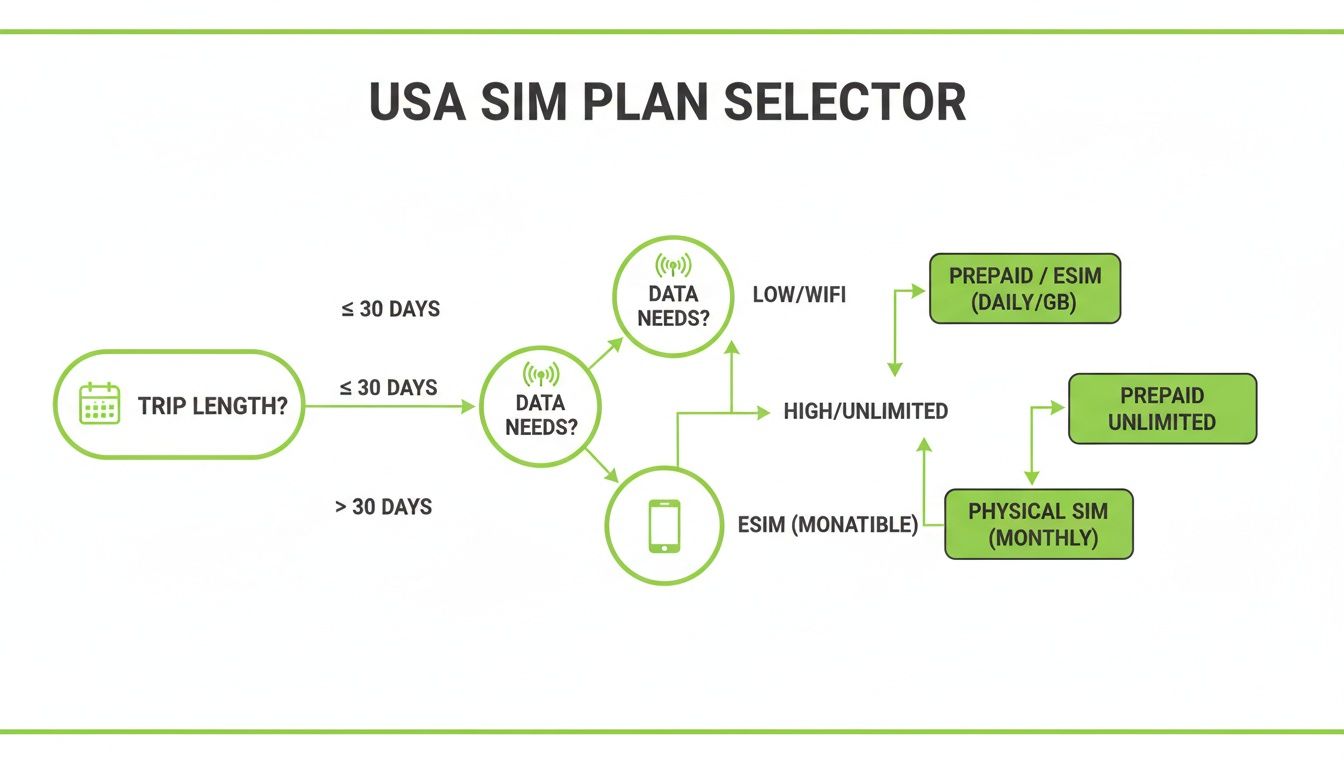
As you can see, things like your trip length and how much data you burn through are the key factors that point you toward the most logical—and cheapest—choice.
Ready to find the perfect eSIM for your USA trip? At eSimGuide.com, we compare plans from over 22 providers to help you get the best deal. Find your ideal USA eSIM plan today!