
Esim vs Physical Sim: esim vs physical sim for travelers
The real difference between an eSIM and a physical SIM boils down to one thing: an eSIM is a digital chip built right into your phone, activated with a quick QR code scan for instant data. A physical SIM, on the other hand, is that tiny plastic card you’ve been popping in and out of your phones for years.
Your choice really comes down to whether you prefer modern, digital convenience or the old-school, universal familiarity of a physical chip.
The Modern Traveler's Connectivity Dilemma
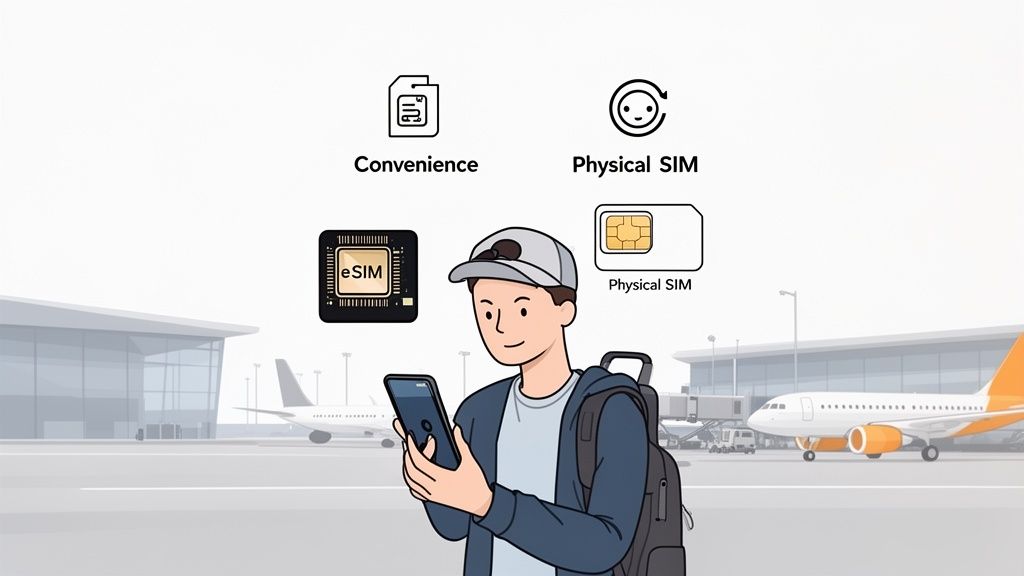
Figuring out how to stay connected abroad isn't just a last-minute task anymore—it's a core part of travel planning. The debate between using an eSIM or a physical SIM has totally changed how we think about international data, freeing us from the hassle of airport SIM kiosks and the shock of expensive roaming bills.
The physical SIM is that classic, removable card we all know. It holds your account info and connects you to a carrier's network. It’s reliable and works in just about any phone, but it also means hunting down a local shop, fumbling with a tiny piece of plastic, and hoping you don't lose your original SIM in the process.
An eSIM, or embedded SIM, does the exact same job but without the plastic. It's a small chip soldered directly onto your phone's motherboard, and you activate it digitally. This is a game-changer for travelers. You can buy and install a data plan from your couch before you even pack your bags. If you want to dive deeper, you can learn more about what an eSIM is and how it works in our detailed guide.
The move to digital is happening fast. Recent stats show that 65% of travelers now reach for an eSIM over a physical one for international trips, mostly because it's easier and cheaper. It also turns out that 70% of these travelers are grabbing data-only eSIM plans, skipping pricey voice and text packages they barely use. The industry is on track for 76% of all smartphone connections to be eSIM-based by 2030, marking a huge shift in how we connect.
Key Takeaway: For travelers, the main difference is convenience. eSIMs offer instant, digital activation from anywhere, while physical SIMs require you to find one and install it by hand.
To put it all into perspective, here’s a quick rundown of how the two stack up for someone on the road.
eSIM vs Physical SIM At a Glance for Travelers
This table gives you a high-level look at the key differences between eSIM and physical SIM cards, focusing on what matters most when you're traveling internationally.
| Feature | eSIM (Embedded SIM) | Physical SIM (Subscriber Identity Module) |
|---|---|---|
| Activation | Instant digital setup via QR code or app | Requires physical purchase and insertion |
| Flexibility | Store multiple plans; switch carriers easily | Tied to one carrier; requires a physical swap |
| Availability | Purchased online, anytime, from anywhere | Must find a physical store or airport kiosk |
| Security | Cannot be physically stolen or lost from the device | Can be lost, stolen, or damaged |
| Compatibility | Supported by most newer smartphones | Works with nearly all phones, including older models |
Ultimately, eSIMs offer unmatched flexibility and ease, perfect for the modern traveler who values convenience. Physical SIMs remain a reliable fallback, especially for older devices or those who prefer a tangible, familiar process.
Comparing Core Features for Travelers
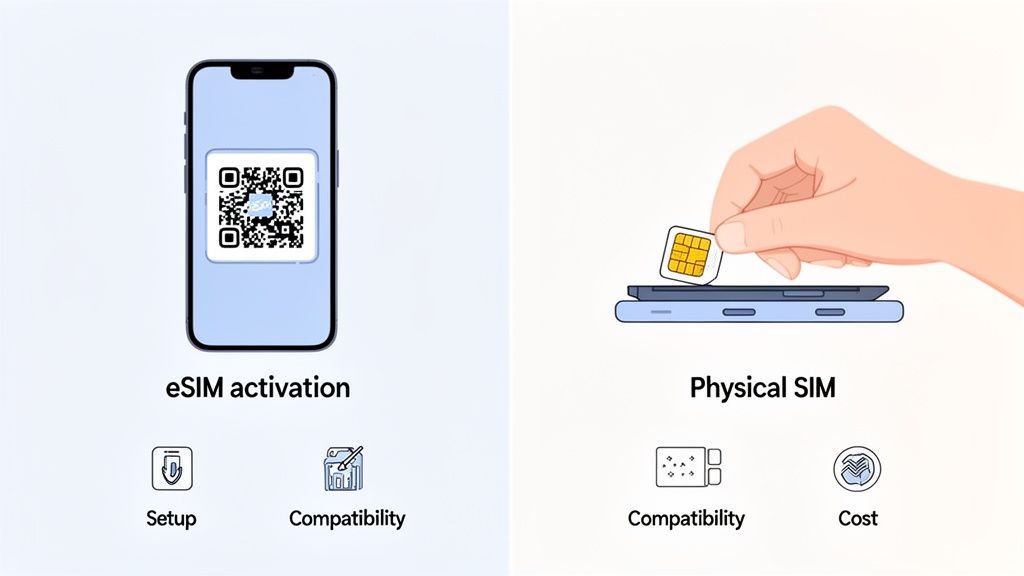
When you’re weighing an eSIM against a physical SIM, it’s the practical, on-the-ground differences that really matter. Both get you online, sure, but how they handle setup, which devices they work with, and what they cost will completely shape your travel experience.
Getting these details right before a trip is crucial. The choice you make impacts everything from your first few minutes after landing to your final bill. Let’s break down where each one wins and loses for a traveler.
Setup and Activation
This is where the difference between digital convenience and manual hassle becomes crystal clear.
An eSIM offers what is essentially instant, location-independent activation. You can hop online and buy a plan from a provider like Airalo or Holafly before you even pack your bags. Activation is as simple as scanning a QR code they email you, and boom—the plan is installed on your phone.
This completely sidesteps that all-too-familiar airport ritual: hunting down a SIM card kiosk, navigating language barriers, and fumbling with a tiny chip and an ejector tool. You can literally be online before the plane even gets to the gate.
Key Differentiator: The magic of an eSIM is its "zero-touch" setup. There's nothing to physically handle, no tool needed, and zero risk of misplacing your primary SIM card while you’re thousands of miles from home.
A physical SIM, on the other hand, is a hands-on affair. You have to find a store upon arrival, pick a plan, and then perform the delicate surgery of swapping the card into your phone. It’s usually manageable in major airports, but it can turn into a real headache if you land late at night or fly into a more remote destination.
Device Compatibility
Compatibility is a huge factor, and for now, it's one of the few areas where physical SIMs still have a slight advantage—though that lead is shrinking fast.
Physical SIM card slots have been the standard for decades. That means pretty much any phone made in the last ten years, from a top-of-the-line flagship to a budget-friendly burner, will take a physical SIM. Their universal nature makes them a fallback option for travelers with older or cheaper devices.
eSIM technology, however, is mostly found in newer and more premium smartphones. Adoption is definitely picking up steam—most new models from Apple, Google, and Samsung have it—but plenty of older or less expensive Android phones are still missing the feature.
Before you buy an eSIM plan, you absolutely must check if your phone is compatible. Most eSIM providers have a quick checker tool on their websites. As a rule of thumb, all iPhones since the XS, XR, and 11 models have eSIM capability.
Cost and Roaming
For most travelers, the decision boils down to cost. This is where eSIMs really pull ahead by completely upending the old, expensive roaming model.
Using your home carrier's physical SIM abroad often means getting hit with outrageous international roaming fees, which can run $10 to $12 per day. Buying a local physical SIM when you land is a cheaper workaround, but it’s still an extra step and not always the best deal for multi-country trips.
eSIMs change the game entirely. They operate in a fiercely competitive global marketplace, letting you buy data plans directly for the specific country or region you’re visiting. And all that competition pushes prices way down.
Here’s what that looks like in the real world:
- Traditional Roaming (Physical SIM): On a 10-day trip to Europe, you could easily rack up $100 or more in daily roaming fees from a major US carrier.
- eSIM Plan: For that same trip, a regional Europe eSIM with 10 GB of data will only set you back around $15 to $20.
The difference isn't just a few bucks; it's a completely different approach to paying for data. By decoupling data from your main carrier, eSIMs give travelers affordable, upfront pricing without any fear of bill shock. This makes budgeting for your trip way easier and cements the eSIM as the smarter financial choice for almost any international travel.
Security and Flexibility: Where the Real Battle Is Won
Connectivity is just the starting point. When you’re actually on the road, the real-world differences between an eSIM and a physical SIM pop up in two places that matter most: security if your phone gets stolen, and the flexibility to adapt when your travel plans inevitably change.
A physical SIM card's biggest liability is right in its name—it's physical. If your phone gets lost or swiped, that little plastic chip can be popped out and slipped into another device in seconds. This gives a thief instant access to your phone number, which is a scary thought when you realize it's often the key to your two-factor authentication for banking, email, and social media.
An eSIM, on the other hand, is soldered directly onto your phone’s motherboard, making it impossible to remove. This simple fact completely shuts down the physical vulnerability. If your phone is stolen, the eSIM profile stays locked to your device and can be remotely disabled, protecting your digital identity far more effectively than a flimsy piece of plastic ever could.
The Bottom Line: An eSIM's embedded design is a massive security upgrade. It stops SIM-swapping fraud cold and protects your phone number if your device is stolen—a constant risk for any traveler.
Flexibility That a Physical SIM Can't Match
Beyond the security angle, the sheer flexibility of eSIM technology is what makes it a game-changer for frequent travelers. A physical SIM locks you into one carrier profile at a time. To switch networks—say, when you cross the border from Spain into Portugal—you have to hunt down a new physical SIM card.
That whole process is a drag, especially on a multi-country trip. You have to find a local shop, fiddle with those tiny plastic cards, and try not to lose your primary SIM from back home.
In contrast, most modern smartphones can store multiple eSIM profiles at once. Think about it: you could have your US home plan, a regional European plan, and another one for a quick side trip to Japan all loaded onto your phone. Switching between them is as easy as a few taps in your settings menu, giving you instant data the moment you touch down.
This convenience is a huge reason the technology is taking off. The global eSIM market was valued at $1.4 billion in 2023 and is expected to rocket past $12 billion by 2026. Travelers are driving this growth, using platforms like eSimGuide.com to get connected remotely. While physical SIMs are still common in older devices, eSIM shipments blew past 503 million units in 2024, with consumer downloads jumping by 56%. You can dig into more stats about the explosive growth of the eSIM market if you're curious.
How This Plays Out in the Real World
To see what this flexibility really means, let's look at a couple of common travel scenarios:
- The Spontaneous Border Hop: You're in France and decide to take a last-minute weekend trip to Switzerland. With a physical EU SIM, you might find out your plan doesn't cover non-EU countries, sending you on a wild goose chase for a Swiss SIM. With an eSIM, you can just buy and activate a Swiss data plan from your hotel room in minutes.
- Juggling Work and Personal Lines: A business traveler can keep their primary work number on one eSIM profile while using a cheap, data-only local eSIM for Google Maps and browsing. This keeps work and personal expenses cleanly separated without needing two phones or constantly swapping physical SIMs.
This kind of on-demand connectivity just wasn't possible with physical SIMs. It's a fluid, adaptable approach to staying online that perfectly fits the unpredictable nature of modern travel, making the eSIM the clear winner for anyone who values both security and adaptability on the go.
Which SIM to Choose for Your Travel Style
Knowing the tech specs is one thing, but figuring out which SIM to actually pack for your trip is what really counts. The right choice boils down to your travel style, your destinations, and even the phone you're carrying. Let's break down a few real-world scenarios to see which one makes the most sense on the ground.
Making the right call here will save you a ton of time, money, and hassle. It’s time to move past the theory and see how this plays out for different kinds of travelers.
The Multi-Country Euro-Trip
Picture this: you're backpacking across Europe for a month, hitting Paris, Rome, Berlin, and Prague. With a physical SIM, this trip is a connectivity nightmare. You'd either have to hunt down a single EU-wide SIM (which might get spotty in some countries) or go through the pain of buying a new SIM card every time you cross a border.
This is where an eSIM is the clear winner. Before you even leave home, you can buy a regional Europe eSIM. The moment you land in Paris, you scan a QR code, and you're online. When you hop on the train to Rome, your phone just stays connected. No stores, no tiny plastic cards, no fuss—it's a massive advantage for fast-paced, multi-country trips.
For country-hoppers, the eSIM isn't just a convenience—it's a core travel tool. The freedom to switch between regional and country-specific plans on the fly eliminates the biggest logistical hurdle of staying connected across borders.
The Digital Nomad in Southeast Asia
Now, think about a digital nomad spending three months bouncing between Thailand, Vietnam, and Indonesia. Their needs are totally different. They need consistent, fast data for work, plus a local number for things like opening a bank account or dealing with landlords. For this, a hybrid approach is often best.
You could use your phone's physical SIM slot for a local Thai SIM card, which often comes with huge data packages and a local number for next to nothing. Seriously, the local deals are way cheaper than most international eSIMs for long stays. At the same time, you can have a Vietnam eSIM loaded and ready to activate the second you land in Hanoi.
This dual-SIM strategy gives you the best of both worlds:
- Physical SIM: Unbeatable value and a local number for long stays in one country.
- eSIM: Perfect for instant data when you move between countries, so you're never offline.
The Business Traveler Needing Instant Access
For a business traveler, time is money. You land in Tokyo for a 48-hour trip and need to be online the second the plane's wheels hit the tarmac. You have to check emails and navigate to your first meeting, not waste time fumbling with a physical SIM at an airport kiosk.
This is the perfect use case for a pre-purchased eSIM. You can buy and install your Japan data plan while you're still in the departure lounge at home. When you arrive, you just switch your cellular data line to the eSIM, and you're instantly connected. This is a professional necessity that physical SIMs just can't match. The infographic below also shows how an eSIM adds a crucial layer of security if your phone gets lost or stolen.
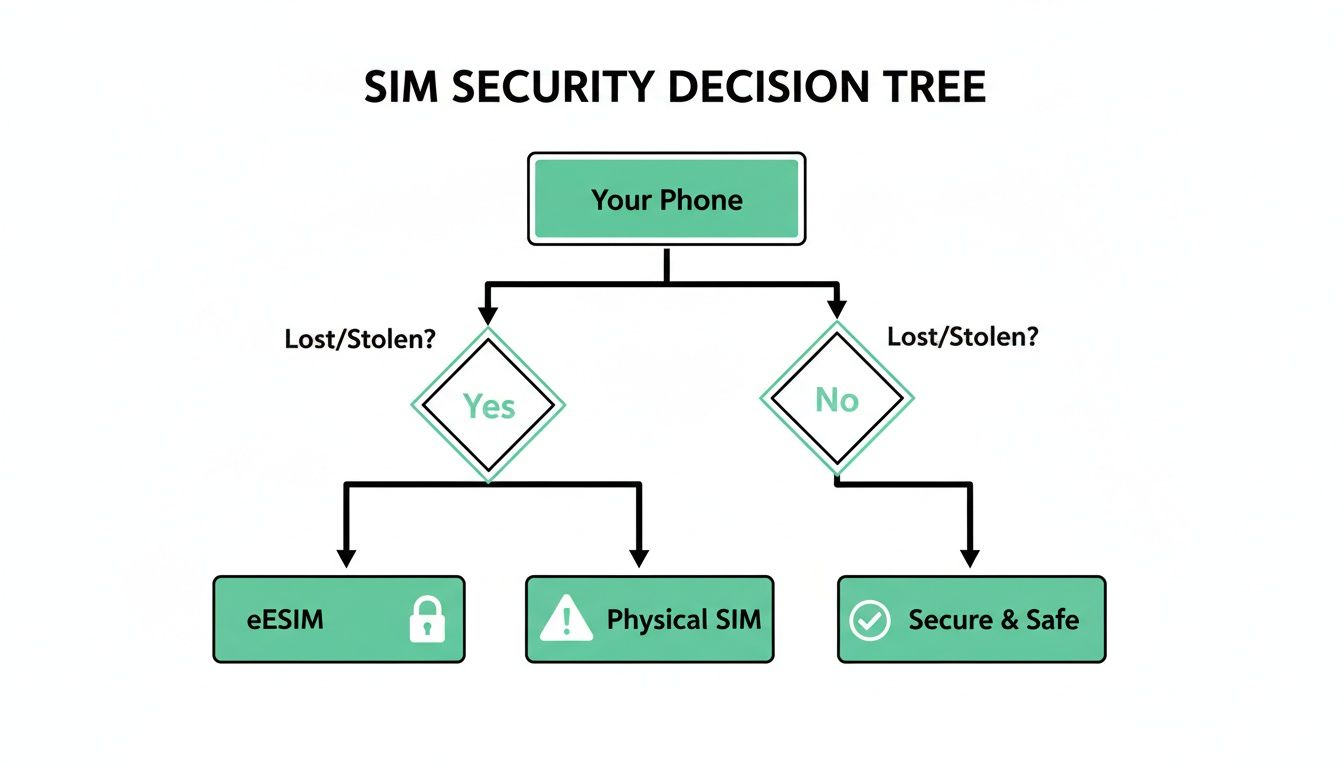
This visual drives home a critical point: an eSIM can't be physically removed by a thief, making it a much safer bet for anyone worried about device security while traveling.
When a Physical SIM Is Still the Best Choice
Despite all the perks of eSIMs, there are times when a good old-fashioned physical SIM is the only way to go. If you're traveling with an older phone that doesn't support eSIMs, a physical SIM is your answer. Its universal compatibility is its greatest strength.
Also, in some remote destinations or developing countries, local physical SIMs might offer way better coverage or pricing than the available eSIM plans. It always pays to do a little research before you fly. If you're planning a trip, our complete guide on using an eSIM for international travel has more practical tips. At the end of the day, matching the right tech to your trip and your phone is the key to a smooth, connected journey.
To make the decision even easier, here’s a quick guide based on different traveler profiles.
Decision Matrix: Best SIM Type by Traveler Profile
| Traveler Profile | Primary Need | Recommended SIM | Key Rationale |
|---|---|---|---|
| The Backpacker | Flexibility across multiple countries, budget-friendly data | eSIM (Regional Plan) | Instantly switch networks at borders without buying new SIMs. One plan covers the whole trip. |
| The Digital Nomad | High-speed, long-term data + local phone number | Hybrid (Local Physical SIM + eSIM for travel days) | A local SIM offers the best rates for long stays. An eSIM provides a bridge between countries. |
| The Business Traveler | Instant connectivity upon arrival, high security | eSIM (Pre-purchased) | Activate data the moment you land. Cannot be removed if the phone is stolen. |
| The Family Vacationer | Simple, reliable data for one or two destinations | Physical SIM or eSIM | A local physical SIM is often cheaper. An eSIM is more convenient if the family has compatible phones. |
| The Off-the-Grid Adventurer | Connectivity in remote or developing areas | Physical SIM (Local) | Local carriers often have better coverage and deals in remote regions where eSIM options are limited. |
| The Tech-Savvy Traveler | Managing multiple lines (work, personal, travel) | Dual SIM (using multiple eSIMs) | Keep home number active while using cheap local data. Switch between profiles effortlessly. |
This table should help you quickly identify the best approach for your specific needs, ensuring you spend less time worrying about connectivity and more time enjoying your trip.
How to Activate and Manage a Travel eSIM
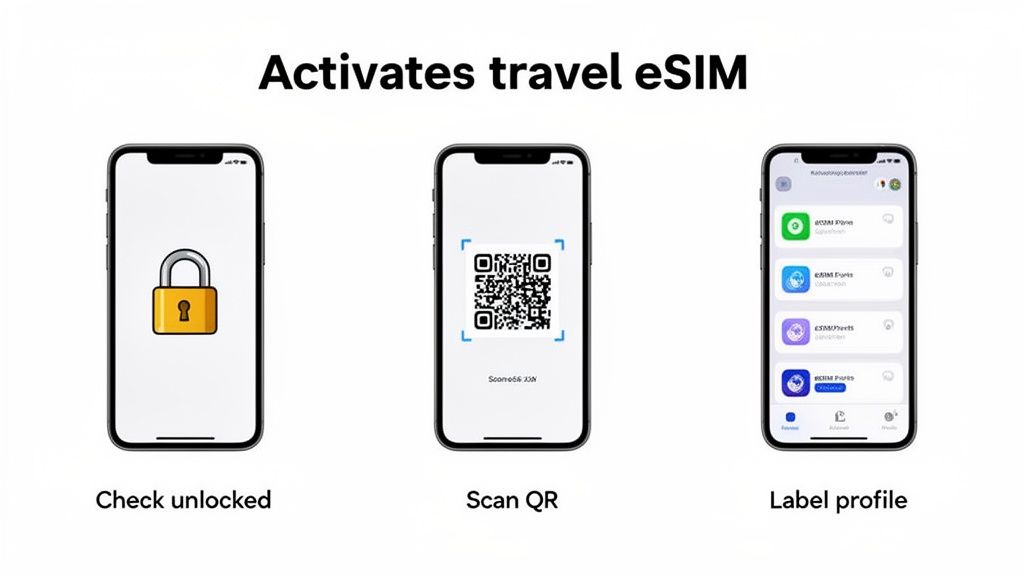 , troubleshooting, real-world travel recommendations, and an FAQ addressing common concerns.0e-9ecc-9e21bba2c556/02b8ae61-c291-4255-a128-7fde6ff809a6/esim-vs-physical-sim-esim-activation.jpg)
Getting an eSIM up and running is far easier than you might imagine. The entire process is digital, which means you can get your travel data sorted out from your couch before you even start packing. No tiny plastic cards, no paper clips—just a few taps on your phone.
Before you start shopping, you need to make sure your phone is ready for the switch. An eSIM only works on a device that is both eSIM-compatible and unlocked from any carrier. If you bought your phone straight from a carrier, you might need to give them a call to unlock it once it's paid off. Not sure if your phone makes the cut? Check our guide that helps you figure out if your phone supports eSIM technology.
Finding and Purchasing Your Plan
Once you've confirmed your phone is good to go, the fun part begins: shopping for a data plan. This is where the real advantage of eSIMs over physical SIMs becomes obvious. Instead of being stuck with whatever overpriced tourist SIM the airport kiosk is pushing, you have access to a global marketplace.
Using a comparison site like eSimGuide.com lets you filter plans by destination, how much data you need, and the length of your trip. Keep an eye on the price per gigabyte and how long the plan is valid to find the absolute best value.
You’ll generally find three types of plans:
- Local eSIMs: These cover a single country. They're perfect if you’re staying put in one place for a while.
- Regional eSIMs: These offer coverage across a group of countries, like a "Europe" or "Asia" plan. They’re a lifesaver for backpacking or multi-stop trips.
- Global eSIMs: These give you connectivity in dozens of countries worldwide, making them ideal for frequent flyers or anyone on a round-the-world adventure.
After you buy your plan, the provider will email you a QR code and some simple instructions.
Pro Tip: Always purchase and install your eSIM profile while you're on a stable Wi-Fi connection before you leave home. The plan’s validity countdown only starts once it connects to a network in your destination country, so there's no risk of activating it too early.
Activation and Management on Your Phone
Activating the eSIM is the easiest part of the whole process. You don't need any special tools—just your phone’s camera and the QR code you were emailed. The whole thing usually takes less than two minutes.
Just follow these simple steps:
- Open Settings: On your phone, head to your Cellular or Mobile Data settings menu.
- Add Cellular Plan: Look for an option that says "Add eSIM," "Add Cellular Plan," or something similar.
- Scan the QR Code: Your phone’s camera will pop up. Point it at the QR code from your email.
- Label Your eSIM: Your phone will ask you to give the new plan a name. This is a crucial step! Label it something obvious like "Europe Trip" or "Japan Data." This makes it easy to tell apart from your primary SIM.
- Set Your Default Line: Choose which line to use for voice, messages, and data. When you're traveling, you’ll want to set your new eSIM for Cellular Data but keep your home line as the default for calls and texts.
By properly labeling your eSIMs, you can store several on your device and just toggle between them as needed. This is a level of convenience and control that a physical SIM simply can't match, giving you a smooth, connected experience no matter where you land.
The Final Verdict: Is It Time to Ditch the Physical SIM?
After breaking down eSIMs and physical SIMs, the verdict for most international travelers is pretty clear. If your phone supports it, an eSIM is almost always the smarter choice. It flat-out wins on convenience, cost, and flexibility.
Let's be honest, the old ritual of hunting for a local SIM card shop, fumbling with that tiny tray-popper pin, and swapping a delicate piece of plastic feels clumsy now. The eSIM just modernizes the whole process.
This is especially true for digital nomads and anyone hopping between multiple countries. Being able to buy and activate a data plan online before you even land is a game-changer. You can step off the plane in Spain, switch to your Portugal plan a few days later, and never miss a beat—all without searching for a single kiosk.
When a Physical SIM Still Has Its Place
But don't toss your SIM ejector tool just yet. The physical SIM isn’t obsolete, and it remains the undisputed champ in a few key situations. If you’re rocking an older smartphone that doesn't have an eSIM chip, a physical card is your only option. Its universal compatibility is its greatest strength.
It also makes a ton of sense for long-term stays in a single country, particularly in places like Southeast Asia. You can often walk into a local shop and snag a physical SIM with a massive data package for a fraction of the cost of a regional eSIM. For travelers who prioritize a rock-bottom budget over instant convenience, this is the way to go.
The Bottom Line: Your phone and your travel style should guide your decision. For short trips, multi-country tours, and the sheer ease of immediate connectivity, the eSIM is king. For older phones or a deep dive into one budget-friendly destination, the classic physical SIM still holds its ground.
Ultimately, the eSIM is the future of travel connectivity. It’s more secure, more agile, and just better aligned with how we move around the world today. While the physical SIM served us well for decades, its limitations are becoming harder to ignore. Check your phone's specs, look at your itinerary, and you'll know exactly which one to pack for your next adventure.
Still Have Questions? Let's Clear Things Up
Even after a deep dive, a few practical questions always pop up when deciding between an eSIM and a physical SIM. Here are some straight answers to the most common things travelers ask.
We'll tackle the real-world stuff: data caps, hotspots, and whether an eSIM actually saves you money.
Are eSIMs Cheaper Than Local Physical SIMs?
It really depends on your trip. For shorter getaways or multi-country hops, an eSIM is almost always a better deal than getting hit with expensive daily roaming from your home carrier. A regional eSIM for Europe, for example, might run you $15-$20 for a plan that lasts your whole trip—a huge saving compared to the $100+ you could rack up in roaming fees.
But if you're settling into one country for a longer stay, especially somewhere like Southeast Asia, a local physical SIM card is the undisputed king of cheap data. It's not uncommon to find local deals like 30 GB for under $5, a price point that global eSIM providers just can't compete with.
Can I Use My Phone as a Hotspot with an eSIM?
Yes, most of the time you can. Whether you can tether other devices comes down to the specific eSIM provider and their agreement with the local network. Big names like Airalo and Holafly usually allow hotspotting, but it's something you absolutely have to confirm in the plan details before you click "buy."
Heads Up: Watch out for "unlimited" data plans. They often come with a "fair use" policy that gives you a certain amount of high-speed data (say, 3-5 GB per day) before throttling you to painfully slow speeds. This cap can apply to your hotspot data, too, sometimes at an even lower limit.
Do eSIMs Come with a Phone Number?
The vast majority of travel eSIMs are data-only. This is the main reason they're so affordable—they don't include a local phone number for making old-school calls or sending SMS texts. For most travelers, this is perfectly fine, since you can still make calls and send messages through apps like WhatsApp, FaceTime, or Skype using your data.
If you absolutely need a local number to make restaurant reservations or call a taxi, you have a couple of options:
- Hunt down an eSIM provider that specifically offers plans with voice and text. They're less common but they exist.
- Use your phone's dual-SIM capability. Keep your home number active on its physical SIM or another eSIM for calls and texts, while using the travel eSIM just for cheap data.
Can I Switch Back to My Physical SIM at Any Time?
Absolutely. Bouncing between your travel eSIM and your main physical SIM is a breeze. You just dive into your phone's cellular settings and choose which line you want to handle data, voice, and messages. It’s incredibly useful for keeping your home number active for important calls or texts while using the cheap local data from your eSIM.
Once you’re back home, just flip the settings back to your physical SIM and deactivate the eSIM line. You can leave it on your phone, ready to be reactivated for your next adventure. This flexibility is one of the biggest wins for eSIMs.
Ready to stop overpaying for roaming and get connected the moment you land? eSimGuide.com lets you easily compare eSIM plans from over 22 providers worldwide. Find the perfect data plan for your destination and travel style at https://esimguide.com.


