

Your Ultimate Guide to International Calling VoIP for Travelers
Ever found yourself in a Parisian café wondering how you can call your home office for practically nothing? The secret is international VoIP calling, a technology that uses your internet data to make calls, completely sidestepping the eye-watering fees of traditional phone networks. It’s a lot like sending an email instead of a snail-mail letter—it’s faster, way cheaper, and all it needs is a digital connection.
How VoIP Turns the Internet Into a Phone Line
At its heart, Voice over Internet Protocol (VoIP) is a clever trick that turns your voice into tiny digital packets of data. When you talk, your VoIP app grabs the sound, chops it up, and zips those pieces across the internet using your data connection, whether that’s from a travel eSIM or the local coffee shop’s Wi-Fi. On the other end, those packets are reassembled in the right order, and the person you’re calling hears you as if you were in the next room.
This whole process bypasses the old-school Public Switched Telephone Network (PSTN)—that ancient web of copper wires and physical switches that traditional phone calls still depend on. By using the internet as the highway for your call, you avoid the hefty tolls that mobile carriers love to charge for international connections.
The Tech That Makes It All Work
Two key pieces of technology work in tandem to make your international VoIP calls happen smoothly:
- SIP (Session Initiation Protocol): Think of SIP as the air traffic controller for your call. It’s a signaling protocol that does the behind-the-scenes work of setting up, managing, and tearing down the connection between you and the person you're calling. It handles things like making their phone ring and keeping the line stable.
- Codecs (Coder-Decoder): Codecs are like expert translators for your voice. They compress your analog voice into lean digital packets to send over the internet, then decompress them back into clear audio on the other side. Modern apps automatically pick the right codec to balance call quality with data usage, so you don’t have to think about it.
The real magic of VoIP is that it treats your voice like any other type of data. To the network, a phone call is just a stream of information, no different from loading a webpage or streaming a video. This is why a simple, stable data plan is all you need for affordable global communication.
The shift to this technology has been seismic. The global VoIP market has exploded, becoming a cornerstone of modern communication for anyone on the move. This growth is driven by the mass exodus from traditional phone lines, with over 40% of all global voice calls now being delivered via VoIP—and that number is still climbing. You can dig deeper into these powerful VoIP market statistics to see just how fast the industry is changing.
VoIP Costs vs. Traditional Roaming: A Clear Breakdown
Let's be honest: the main reason travelers are flocking to international calling VoIP is to dodge those heart-stopping phone bills. Traditional mobile roaming can feel like a financial minefield, where a quick call home somehow ends up costing more than dinner. VoIP completely flips that script, turning what was once a major travel expense into a predictable, minor cost.
Instead of paying your home carrier several dollars a minute, VoIP services often charge just pennies. It works because your calls ride on the internet—via your eSIM data or Wi-Fi—completely bypassing the expensive, old-school infrastructure that traditional carriers rely on for international connections. The difference in price isn't just small; it's often jaw-dropping.
This chart really puts the industry's shift into perspective, showing just how fast internet-based calling is taking over.

The trend is undeniable. VoIP is quickly becoming the new normal for anyone who needs to stay connected globally.
A Practical Cost Showdown
To really see the savings in action, let’s imagine a real-world scenario. Picture a digital nomad in Portugal who needs to make daily calls to clients back in the States. With traditional roaming, those calls could easily balloon to hundreds of dollars over a month. But with a VoIP app and a cheap data eSIM? The same calls would probably cost less than their morning coffee.
The real game-changer is predictability. VoIP tells you exactly what you're paying per minute, so you can actually budget your communication costs. It's a world away from the confusing and often punitive pricing of international roaming packages.
International calling rates with VoIP have plummeted compared to what the old carriers charge. Popular destinations like the USA and Western Europe often cost somewhere between $0.005–$0.03 per minute. For example, you can find providers offering calls to France for around $0.03 per minute and the UK for about $0.02.
Comparing Your Calling Options
Let's put some numbers to this. Here’s a quick comparison of what you might pay for a 10-minute call from Europe to the USA using different methods.
International Call Cost Comparison Per Minute
| Calling Method | Typical Per-Minute Rate | Estimated 10-Minute Call Cost |
|---|---|---|
| International VoIP | $0.02 - $0.05 | $0.20 - $0.50 |
| Carrier Roaming | $1.00 - $3.00+ | $10.00 - $30.00+ |
| Local Physical SIM | Varies Widely | Often requires a separate plan |
The numbers don't lie—VoIP offers massive savings.
This is just one piece of the puzzle for a savvy traveler. Smart communication choices are crucial, but so is smart financial planning. For instance, knowing how to approach avoiding currency conversion fees when traveling can protect your budget even further. By combining smart tech with smart money habits, you keep more cash in your pocket for the experiences that truly matter.
And if you're looking for more ways to cut down on mobile expenses, be sure to check out our guide on how to avoid roaming charges.
Getting Up and Running With VoIP for Your Trip
You might be surprised how easy it is to get international calling VoIP set up. Think of this as your practical playbook for making cheap calls from anywhere, long before your flight takes off. We can boil it down to just a few simple steps.
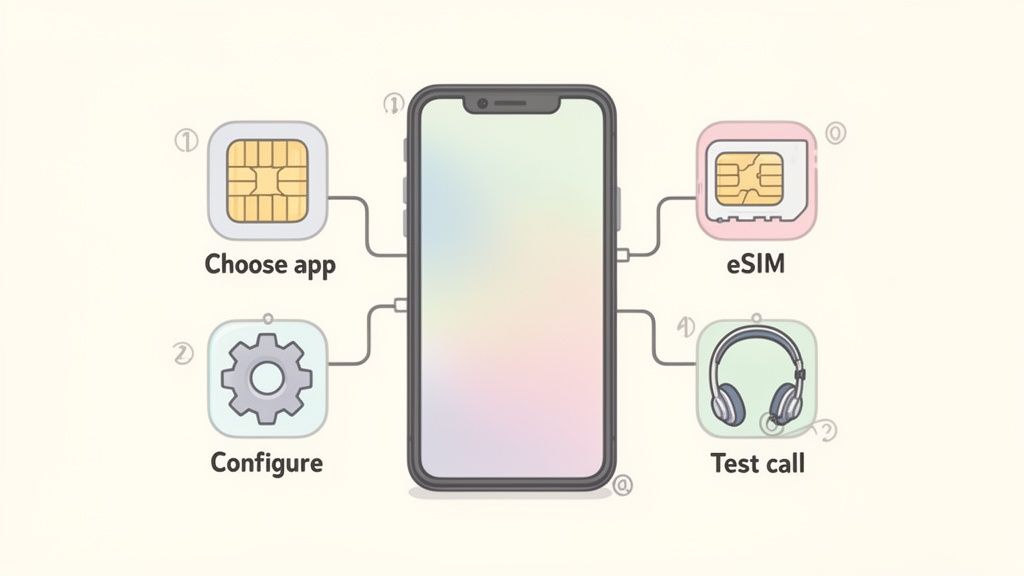
The whole thing really just comes down to having a decent internet connection and the right app on your phone. It's like packing a digital toolkit for your travels—once it's configured, it just works quietly in the background when you need it.
Step 1: Pick the Right VoIP App
First things first, you need to choose your VoIP app. You've got tons of options, from household names like Skype and Google Voice to more niche services that might offer better rates for the specific countries you're calling.
- For Casual Use: If you're just calling other people who use the same app, something like WhatsApp or FaceTime works perfectly fine. The catch is they can't call regular landlines or mobile numbers.
- For Calling Landlines/Mobiles: This is where services like Skype or Rebtel come in. You just add some credit and can then call any phone number in the world for a super low per-minute rate.
A lot of these providers also offer virtual phone numbers. This is a neat trick: friends and family back home can dial a local number, and it rings your app wherever you are in the world, saving them a bundle on international charges.
Step 2: Lock Down a Solid Data Connection
Here’s the deal: a VoIP call is only as good as the internet it's running on. Relying on spotty café or hotel Wi-Fi is a gamble, not to mention a security risk. If you want clear, consistent calls from anywhere, you need your own data connection.
This is exactly where a travel eSIM comes into its own. An eSIM gives you affordable, local data right in your destination country, letting you sidestep those outrageous roaming fees. You can activate it the second you land and have instant internet for your VoIP calls. Just make sure to confirm if your phone supports eSIM technology before you go.
Step 3: Install, Configure, and Test
Once you’ve got your app and your data plan sorted, the final bit is a breeze. Just download your chosen VoIP app from your phone's app store, set up an account, and top it up with a little calling credit if needed.
Pro Tip: Do yourself a huge favor and make a test call before you leave. Call a friend's landline or a family member's cell to check the audio quality. This is also the time to make sure you've given the app the right microphone and speaker permissions. A simple five-minute check can save you a world of frustration later.
VoIP has become a massively popular tool for travelers for a reason—it just works. The user base is enormous, with estimates pointing to over 3 billion users worldwide by 2024. This huge adoption, including a projected 2.5 billion mobile VoIP subscribers, shows that pairing an eSIM with a VoIP app is now the standard playbook for smart travelers. You can dig into more stats about VoIP's global user adoption if you're curious.
Ensuring Great Call Quality While Abroad
A cheap international calling VoIP service is pointless if the person you're calling sounds like they're gargling seawater. Call quality is the biggest worry for most travelers, but getting that crystal-clear audio is actually pretty straightforward. It all boils down to one thing: your internet connection.
Think of your voice as a stream of tiny digital packets flying across the internet. When your connection is shaky, some of those packets get lost or show up late. This is what causes those classic, frustrating glitches—choppy audio, robotic voices, and awkward silences. A stable, reliable data stream is the secret sauce for a perfect call.
Understanding Your Connection Speed
Before you hit dial, it helps to know a little about what makes a connection good or bad for calls. Two numbers matter most:
- Bandwidth: This is just the size of your internet "pipe"—how much data it can push through at once. You don’t need a firehose for a voice call; a steady 100-200 Kbps is plenty for great audio quality.
- Latency (or Ping): This is the delay—how long it takes for a data packet to travel from your phone to the server and back. High latency is what creates that annoying lag where you end up talking over each other. For a smooth conversation, you want low latency, ideally under 150ms.
You can check both in seconds with a speed test app on your phone. Running a quick test before an important call gives you a heads-up on whether your current connection is up to snuff.
Pro Tips for Troubleshooting VoIP Calls
Even with a solid plan, you'll eventually hit a snag. The good news is that most issues with international calling VoIP are easy to fix.
Don't let one bad experience on a crowded airport Wi-Fi turn you off VoIP for good. More often than not, the problem isn't the app—it's the overloaded, unstable network you're forcing it to run on. A reliable data source is your best friend.
If calls are dropping or the audio is garbled, try these quick fixes:
- Switch Your Network: If you’re on a congested public Wi-Fi (think busy café or hotel lobby), hop over to your eSIM data. Mobile data is often more stable and less crowded, giving your call a much better foundation. Finding the best eSIM for international travel ahead of time ensures you always have a strong backup.
- Restart the App: It sounds too simple, but sometimes just closing and reopening your VoIP app is all it takes to clear out a temporary glitch.
- Move to a Better Spot: When you're using mobile data, your physical location makes a huge difference. Try moving closer to a window or just walking to a spot with a stronger cellular signal—it can completely change your call quality.
Staying Secure While Making VoIP Calls
Making an international VoIP call from a busy airport lounge or that charming little café down the street is incredibly convenient, but public Wi-Fi is a security minefield. These open networks are a playground for anyone looking to snoop on your digital life, including your calls. The first rule of travel communications? Treat every public network like it’s being watched.
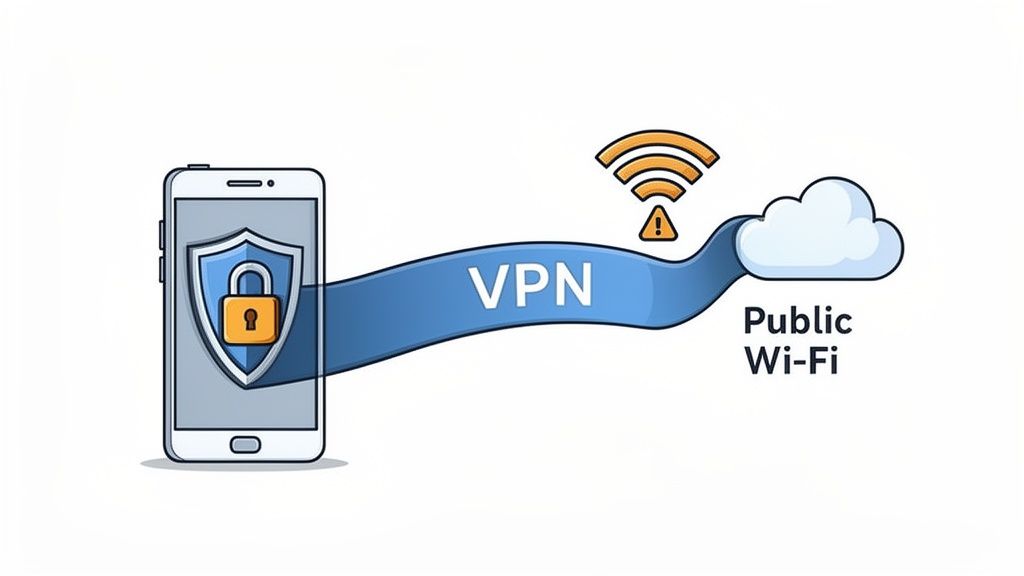
This is where a VPN (Virtual Private Network) becomes your best friend. Think of it as your own private, encrypted tunnel through the public internet. When you connect to a VPN before making a VoIP call, all your data—every single voice packet—gets scrambled and hidden from prying eyes on the same network. It's a non-negotiable layer of protection for any traveler relying on public Wi-Fi.
Prioritizing Encryption and Strong Practices
Beyond just locking down your network connection, the security of the VoIP app itself is just as critical. The gold standard to look for is end-to-end encryption (E2EE). It’s a fancy term for a simple promise: only you and the person you're calling can listen to the conversation. Not even the service provider can get in the middle.
When choosing a VoIP provider, look for them to explicitly mention end-to-end encryption. Services that offer it are showing a real commitment to user privacy, giving you peace of mind that your private conversations stay private, no matter where you are.
Finally, don't forget the digital security basics that apply to everything you do online, including your VoIP accounts. These simple habits can save you from a world of hurt down the road.
- Use Strong, Unique Passwords: Never, ever reuse passwords from other accounts. A unique, complex password for your VoIP service is your first line of defense.
- Enable Two-Factor Authentication (2FA): If your provider offers it, turn it on. That extra verification step makes it exponentially harder for someone to break into your account.
- Watch Out for Phishing Scams: Be deeply skeptical of any unexpected email or message asking for your login details. Legitimate companies will never ask for your password.
By layering these practices—using a VPN, picking an encrypted service, and keeping your account hygiene sharp—you can confidently use VoIP for international calls without putting your privacy at risk.
Got More Questions About Using VoIP for Travel?
Even after getting the basics down, most travelers have a few lingering questions before they're ready to fully trust VoIP on the road. Let's tackle the most common ones.
Can I Actually Receive Calls on a VoIP Number?
Absolutely. This is one of the best parts. Most VoIP services let you grab a virtual phone number from back home. Anyone can dial that number like normal, and it rings right in your app, whether you're in a café in Paris or a hotel in Tokyo.
It’s the perfect way to let family, friends, or even clients reach you without them ever knowing you're abroad—and without them having to pay a cent for an international call.
How Much Data Does a VoIP Call Actually Use?
It’s surprisingly little. A typical VoIP call sips data, using only about 0.5 MB to 1.5 MB per minute. To put that in perspective, a full hour-long conversation might only burn through 30 MB to 90 MB.
When your travel eSIM comes loaded with multiple gigabytes, that’s barely a drop in the bucket. It makes talking for hours incredibly cheap.
Your call quality is only as good as your internet. While VoIP can technically work on slow connections, you’ll start hearing that dreaded robotic voice or frustrating delays. For a crisp, clear chat, you really want a stable connection of at least 100–200 Kbps—which is exactly why a reliable data eSIM is a much better bet than spotty public Wi-Fi.
Ready to travel smart and stay connected without the high costs? Check out the best travel eSIMs from over 22 providers at eSimGuide.com. It's the easiest way to find the perfect data plan for your next adventure. Find your plan at https://esimguide.com.


